Ramsey
Insatiable Box Set: Books 1-4Ramsey is an Alaskan werewolf Alpha and the father of Mena. His importance lies less in a private emotional arc than in the legal and political pressure he brings against the Samsa family: he treats marriage as a pact between packs, expects a daughter to provide status and alliance through mating, and challenges Wilder when Adrienne’s wishes overturn that arrangement. Through Ramsey, the novel gives a face to an older werewolf order in which female autonomy is subordinated to paternal and Alpha authority.
Identity and Position
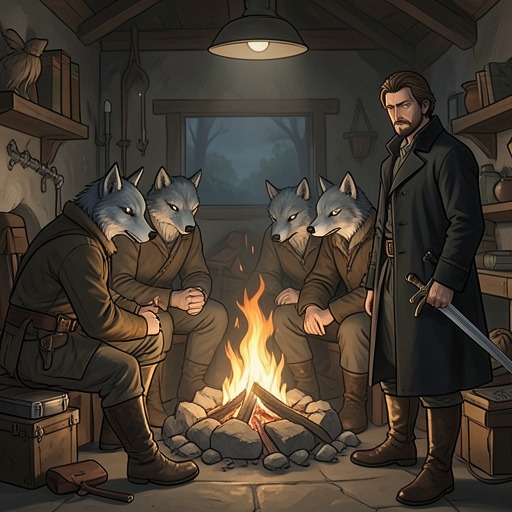
Ramsey rules an Alaskan pack whose compound is enclosed by a rough log fence extending for miles. When Drayton arrives, guards control the gate, and Ramsey receives him in a large stone house before a roaring fire. In human form, Ramsey wears animal skins, unfinished leather trousers, a fur poncho, and a fur cap to imitate civilization despite possessing natural fur that would normally protect him from the cold. The setting presents him as both territorial ruler and embodiment of a pack culture that remains close to animal custom.
His authority is hereditary as well as personal. Ramsey complains that Wilder’s family, and previously Wilder’s father, have imposed rules on his pack. He therefore sees the Samsa brothers not simply as neighboring Alphas but as a ruling lineage whose authority has become intrusive. His objection is not that werewolf law should be abandoned; rather, he disputes who may interpret and enforce it. That distinction makes Ramsey a political opponent within the same supernatural society, not an outsider to it.
The Dispute Over Mena
Ramsey confronts Wilder after Mena is returned instead of being married to one of the Samsa brothers. He says that Wilder broke a promise and dishonored his daughter, arguing that no one will now mate with her. In Ramsey’s account, Wilder had promised that Mena would marry one of the brothers, but later sent her back because Adrienne, a human female, insisted on a different arrangement. Ramsey treats this as a direct affront to his daughter’s status and to the authority of pack law.
The accusation also reveals Ramsey’s paternal model of marriage. He asks when the powerful Samsa brothers began allowing a human woman to dictate their laws, making Adrienne’s independence itself the scandal. Ramsey does not frame Mena as a person whose preference must be considered; he frames her marriage as an obligation that powerful males have undertaken and then failed to complete. His complaint therefore joins family honor, female status, and inter-pack diplomacy into a single demand.
Wilder answers that he never had the right to dictate whom his brothers would mate with. The brothers are all Alphas and possess equal status within the Samsa pack, so their refusal to mate with Mena cannot be corrected by Wilder’s command. Ramsey counters that Wilder claims authority over all werewolves and must enforce that authority if he expects the packs to obey him. Wilder maintains instead that his brothers’ equality limits his power. The argument exposes a constitutional tension in the werewolf order: collective obedience to an Alpha coexists uneasily with the autonomy of other Alpha males.
Marriage as Pack Politics
Ramsey proposes a settlement that would prevent open conflict: Lycell should mate with Mena and give her status in his pack. Lycell accepts responsibility for the crisis and asks what he must do to prevent war, but the proposed solution still treats marriage as a political remedy rather than a mutual choice. Adrienne immediately objects that Lycell cannot make such a commitment. Her interruption marks the boundary Ramsey refuses to recognize—the boundary between a pack’s authority to arrange alliances and a woman’s authority to decide whether she will enter one.
The contrast is sharpened by Mena’s later situation. Under the old werewolf order, werefemales live to serve male pack members, depend upon the goodness of Alpha rulers, and derive their value from bearing pups. Mena had previously obeyed her father and married or prepared to marry whomever he selected. Her relationship with Robert changes that pattern: she falls in love with him, becomes valued as his wife, and gains a life not determined solely by Ramsey’s political calculations. Ramsey’s pressure thus represents the system from which Mena’s new marriage offers partial release.
The same conflict appears in the Samsa brothers’ treatment of Adrienne. Wilder declares that Adrienne is his mate and that he will marry her, while Lycell argues that her pregnancy should make him the husband who claims her. Adrienne rejects both attempts to settle the matter without her and states that she wants to marry Wilder, Lycell, and Drayton. Ramsey’s dispute with Wilder belongs to this wider struggle over whether a female mate is an exchanged resource, a source of heirs, or an active chooser whose consent reorganizes the pack.
Relation to Werewolf Law
Ramsey’s claims become especially significant because the novel presents several overlapping legal systems. Werewolves possess inherited laws internalized across generations; Wilder, as head of a pack extending from the Americas to Russia, is expected to enforce them. Yet the Samsa brothers also operate under an internal agreement that they remain together, share authority as Alphas, accept Wilder’s choice of mate, and allow the chosen female to leave if she rejects the shared arrangement. Ramsey invokes communal law and paternal promise, while Wilder invokes Alpha equality and the brothers’ pact.
These systems do not produce one stable answer. Ramsey believes a promise made by Wilder binds the family to Mena. Wilder believes he cannot compel his brothers. Adrienne insists that neither claim erases her choice. The resulting conflict shows law as a contested practice rather than a neutral code: the same institution of mating can be interpreted as paternal duty, Alpha authority, fraternal equality, political alliance, or personal consent depending on who speaks.
Ramsey’s hostility also reveals how threatening Adrienne’s presence is to established pack boundaries. She is human, but her relationship with Wilder gives her influence over a werewolf Alpha household. Ramsey interprets that influence as an inversion of the proper order, whereas the Samsa brothers increasingly incorporate her decision into their marriage and family structure. Her refusal to accept Ramsey’s arrangement therefore carries consequences beyond romance; it challenges the mechanism by which Alphas exchange women to secure alliances and heirs.
Character Function and Significance
Ramsey functions as a patriarchal gatekeeper and a test of the Samsa brothers’ political legitimacy. He demands that his daughter receive a husband and status, threatens the stability of relations among packs, and forces Wilder to explain whether his authority includes control over his brothers. His presence turns a domestic disagreement into a possible inter-pack war, especially because the full moon and heated tempers make violence more likely.
At the same time, Ramsey is not portrayed as an all-powerful ruler. His attempt to dictate Mena’s future fails when she forms a relationship with Robert, and his proposed settlement cannot proceed without confronting Adrienne’s refusal. His authority remains real enough to endanger peace, but it is weakened by competing Alpha claims and by women who do not remain within the roles assigned to them.
Ramsey’s lasting narrative significance is therefore structural. He embodies the older order against which the human-werewolf household is being improvised: a world where fathers arrange daughters, Alphas enforce mating obligations, fertility determines female worth, and pack status is conferred through marriage. The conflicts surrounding him show that the Samsa family’s survival depends not only on reproduction or territorial strength but also on translating between incompatible ideas of law, kinship, and consent.